 +91 253 6630710
 781.258.1274
 +44 (0) 7446 87 37 97
How to Build a Multi-Agent AI System for Customer Support. An Enterprise Engineering Guide


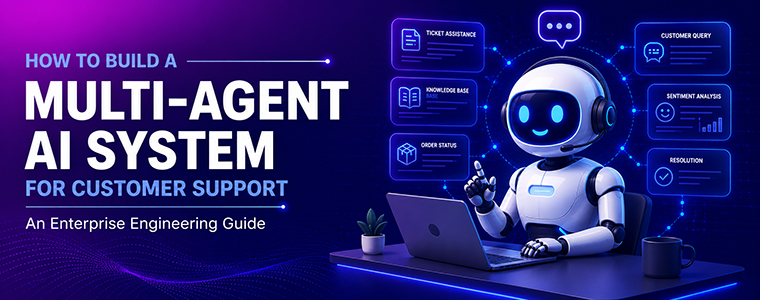

How to Build a Multi-Agent AI System for Customer Support. An Enterprise Engineering Guide
Blog Highlights:
- The Monolithic LLM Bottleneck: Why relying on a single, massive prompt for support pipelines causes catastrophic context drift and high token latency.
- Separation of Concerns: Deep dive into designing distinct AI personas (Triage, Knowledge-RAG, QA, and Human Escalation) that execute targeted tasks.
- The Multi-Agent Tech Stack: An evaluation of orchestrating frameworks like CrewAI, LangGraph, and AutoGen for predictable enterprise runtime and agentic AI workflows.
- Production-Grade Guardrails: How to architect determinism and security into autonomous agent interactions using strict routing topologies.
The era of the simple, single-prompt QA chatbot is officially over.
While baseline conversational interfaces are fine for answering basic FAQ lists, they collapse under the weight of true enterprise customer support. When a customer submits a multi-layered ticket such as a billing dispute that requires cross-referencing an invoice database, analyzing emotional sentiment, checking corporate refund policies, and updating a CRM& a single, monolithic Large Language Model (LLM) prompt often suffers from hallucination, context loss, and unacceptably high token latencies.
To handle complex, multi-step customer operations with absolute determinism, forward-thinking CTOs and COOs are shifting to Multi-Agent Systems (MAS). In practice, this means adopting a multi-agent AI system that decouples a giant, messy support pipeline into a network of autonomous, highly specialized AI agents that collaborate, validate, and execute discrete tasks unlocking up to a 60% reduction in average ticket handling times.
Building an autonomous multi-agent ecosystem requires a specialized architecture. Let's break down the exact engineering blueprint an enterprise AI development company utilizes to take a multi-agent AI system for customer support from architectural design to live production.
1The Multi-Agent Support Topology: Defining the Personas
In a multi-agent architecture, you apply the classic software engineering principle of Separation of Concerns. Instead of expecting one model to be an expert in everything, you build a coordinated digital department.

For a standard enterprise support deployment, an experienced engineering team typically designs four fundamental core agent roles:
A. The Triage & Intent Classifier Agent
- Objective: Parse incoming raw text across chat, email, or API streams to determine user intent, mood, and baseline urgency.
- Tooling: Natural Language Processing (NLP) classifiers or lightweight, low-latency models fine-tuned to tag requests (e.g., "Billing Dispute," "Technical Outage," "Account Management") and output structured JSON data.
B. The Knowledge Retrieval (Agentic-RAG) Agent
- Objective: Act as the internal database researcher. When the Triage Agent flags an intent, the Retrieval Agent uses Model Context Protocol (MCP) or secure APIs to query vector databases, active documentation repositories, and historic case logs.
- Execution: It aggregates raw, authoritative internal truths, filtering out any extraneous corporate data that could cloud the next agent's context window.
C. The Quality Assurance (QA) & Compliance Agent
- Objective: Act as the system's internal supervisor. This agent receives the draft generated by the support response framework and cross-references it against strict factual constraints.
- The Loop: If it detects a hallucination, a compliance violation (such as leaking PII data), or an incorrect tone, it enforces an iterative feedback loop, sending the draft back to the generating agent with clear corrective instructions.
D. The Human Handoff Gateway Agent
- Objective: Safely manage systemic boundaries. If the urgency score crosses a specific threshold, or if the QA agent flags an edge-case looping state, this agent securely aggregates the entire multi-agent interaction history into a concise synopsis and passes it directly into your live helpdesk queue (like ServiceNow or Salesforce) for human intervention.
2Choosing Your Orchestration Framework
Once your personas are defined for your multi-agent AI system, you must choose the underlying runtime engine that will govern how these agents pass messages, share memory, and call external application tools. Partnering with an expert AI development company helps cut through the noise of the open-source landscape to select the right framework for your operational scale and to design reliable agentic AI workflows:
- LangGraph: Ideal for enterprise support where predictability is critical. LangGraph allows developers to model agentic AI workflows as cyclical graphs. This ensures you can enforce deterministic, explicit state-machine loops (e.g., Agent A must pass data to Agent B, and cannot proceed until Agent C approves).
- CrewAI: Highly effective for role-play-centric execution. CrewAI excels at setting up structural "crews" where tasks are sequentially or parallelly delegated to agents with highly specific backstories and operational goals.
- Microsoft AutoGen: Optimized for highly complex, multi-agent conversational structures where agents need to fluidly converse back and forth to solve a highly technical diagnostic problem.
3Engineering Secure Multi-System Tooling
An AI agent is only as powerful as the systems it is safely authorized to interact with. To prevent an autonomous agent from executing an unvetted database operation, engineers use a strict Tool-Calling Architecture.
[Agent Engine] ► [Validates Tool Schema via JSON-Schema] ► [Secure API Gateway] ► [Target CRM/ERP]
When building these integrations, your development architecture must prioritize:
- Model Context Protocol (MCP): Utilizing standard open-source interfaces to allow your AI models to securely read and write data across localized systems without custom, high-maintenance API code wrappers.
- Strict Identity & Access Management (IAM): AI agents must operate under the principle of least privilege. An agent drafting a refund email should never have the direct structural DB credentials to alter enterprise billing ledgers without an explicit webhook requiring a human manager's signature.
4Testing, Evaluation, and Guardrails
Unlike deterministic legacy code, LLM outputs can be fuzzy. To ship a multi-agent support pipeline with confidence, you must implement a rigorous evaluation layer for your agentic AI workflows.
- Guardrail Enforcement: Implement real-time middleware layers (like NeMo Guardrails or Llama Guard) directly between the agents and your customer-facing chat front-ends. These programmatic filters check every single token block for systemic anomalies, toxic language, and prompt-injection attacks.
- Evaluation Pipelines (LLM-as-a-Judge): Prior to production deployment, run synthetic historical support ticket batches through the MAS. A separate evaluation pipeline acts as a judge, checking response parameters against three non-negotiable vectors: Groundedness (is the answer strictly based on your data?), Relevance (did it answer the user's explicit question?), and Tone Adherence.
Enterprise Execution: Moving Past the Hype
Building a multi-agent system that runs seamlessly at enterprise scale isn't about stringing together basic API tutorials; it requires serious infrastructure design, security compliance, and deep platform integration knowledge.
If you are ready to stop experimenting with isolated chatbots and want to deploy a secure, resilient team of autonomous agents customized to your exact operational workflows, you need an established technical partner.
As an elite AI development company, Aress Software designs, builds, and optimizes bespoke agentic systems that seamlessly plug into your existing IT support, CRM, and cloud environments. We ensure your multi-agent architecture drives verifiable operational ROI while maintaining elite data sovereignty and compliance frameworks.
FAQs
Why is a single, monolithic LLM a bottleneck for enterprise customer support?
Monolithic prompts tend to drift in context, hallucinate, and incur high token latency when tickets require multiple, specialized steps (e.g., billing disputes that span invoices, policies, sentiment, and CRM updates). A multi-agent system (MAS) applies separation of concerns dedicating specialized agents to discrete tasks that collaborate and validate each other. This improves determinism, reduces unnecessary context load, and enables targeted tool use, yielding up to a 60% reduction in average ticket handling times.
What are the core agents in the recommended multi-agent topology, and how do they work together?
The flow typically includes four roles:
- Triage & Intent Classifier: Parses raw inputs (chat, email, API) to extract intent, mood, and urgency with lightweight NLP, outputting structured JSON.
- Knowledge Retrieval (Agentic-RAG): Queries internal sources via MCP or secure APIs, aggregating only authoritative, relevant facts.
- QA & Compliance: Supervises drafts for factuality, policy and PII compliance, and tone; enforces an iterative correction loop if issues are found.
- Human Handoff Gateway: Escalates when urgency exceeds thresholds or QA detects looping edge cases, summarizing history and routing to systems like ServiceNow or Salesforce.
How should I choose between LangGraph, CrewAI, and AutoGen for orchestration?
Pick based on your runtime and collaboration patterns:
- LangGraph: Best for predictable, deterministic state machines and explicit approval gates (A → B → C with enforced loops).
- CrewAI: Suited for role-play-centric setups where specialized agents execute sequential or parallel tasks with clear backstories and goals.
- Microsoft AutoGen: Ideal when agents must conduct rich, multi-turn conversations to solve complex diagnostics collaboratively.
How do you securely let agents act on enterprise systems without risking unsafe actions?
Use a strict tool-calling architecture that validates action schemas and funnels all calls through a secure gateway:
- JSON Schema validation → Secure API Gateway → Target CRM/ERP.
- Model Context Protocol (MCP) to standardize read/write across systems without brittle custom wrappers.
- Enforce least-privilege IAM: each agent only has the minimal access it needs; sensitive operations (e.g., altering billing ledgers) require explicit human approval via webhook.
What guardrails and evaluations are needed to make this production-grade?
Add real-time safety and pre-launch testing:
- Guardrails: Middleware (e.g., NeMo Guardrails, Llama Guard) between agents and the UI to catch anomalies, toxicity, and prompt injection at the token/block level.
- Evaluation pipelines (LLM-as-a-judge): Run synthetic historical tickets through the MAS and score outputs on groundedness (strictly your data), relevance (did it answer), and tone adherence.
- Enterprise readiness also entails robust infra design, deep platform integrations, and compliance often accelerated by partnering with an experienced AI development company.

 Few
More from
Dilbagh Dhindsa
Few
More from
Dilbagh Dhindsa
Category: GenAI & Data Engineering
Recent Posts
-
Salesforce
Aress showcases Salesforce delivery strength as Explorer Sponsor at Salesforce World Tour Essentials Sydney
-
Digital
From Vulnerability Management to Threat Detection: Building a Continuous VAPT Program for the Enterprise
-
Digital
AI vs AI: How Enterprises Can Defend Against the New Generation of AI-Powered Cyberattacks
-
Digital
Cybersecurity Awareness Month 2026: How to Benchmark Your Enterprise Security Posture
-
Digital
Cybersecurity Awareness Month 2026: What Should Be on Every Enterprise Security Checklist?