 +91 253 6630710
 781.258.1274
 +44 (0) 7446 87 37 97
Cherwell End of Life (2026): Your Complete Migration Guide to ServiceNow


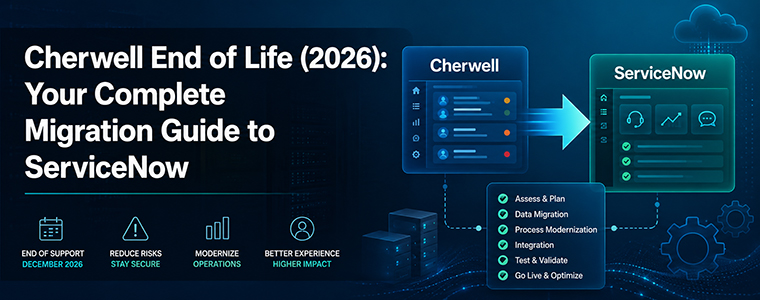

Cherwell End of Life (2026): Your Complete Migration Guide to ServiceNow
As enterprise IT environments continue to evolve, organizations relying on Cherwell Service Management are approaching a critical milestone with Cherwell End of Life (Cherwell EOL). Assuming the platform reaches its end of support in December 2026, IT leaders have a limited window to modernize their service management strategy with a well-planned Cherwell migration.
While an ITSM migration may seem like a technical upgrade, it's actually an opportunity to improve operational efficiency, introduce AI-driven automation, and create a more scalable service management ecosystem.
If your organization still depends on Cherwell, planning your Cherwell to ServiceNow journey now can help reduce business disruption and avoid costly last-minute decisions, enabling a smoother ServiceNow migration.
Blog Highlights
- What Cherwell End of Life means for enterprises
- Risks of delaying your migration
- Common Cherwell migration challenges
- Why ServiceNow has become the preferred replacement
- A practical migration roadmap
- How Aress simplifies ServiceNow migrations
What Does Cherwell End of Life Mean?
End of Life (EOL) means the platform will eventually stop receiving product updates, security enhancements, and vendor support. In practical terms, Cherwell End of Life increases exposure across people, processes, and technology if no action is taken.
For IT teams, this introduces several operational concerns:
- Increased security exposure
- Unsupported integrations
- Higher maintenance costs
- Compliance challenges
- Difficulty finding platform expertise
Running business-critical IT services on an unsupported platform significantly increases operational risk, especially for enterprises with complex service management environments.
Why Waiting Until December 2026 Is Risky
Many organizations underestimate the time required for an enterprise ITSM migration.
A typical migration involves:
- Platform assessment
- Data discovery
- Workflow redesign
- Integration planning
- User acceptance testing
- Employee training
- Production rollout
Large organizations often require several months to complete these activities successfully.
Waiting until the final quarter of 2026 could result in:
- Limited implementation resources
- Increased consulting costs
- Rushed migrations
- Business downtime
- Poor user adoption
Starting early provides more flexibility to optimize processes rather than simply replicating legacy workflows.
The Biggest Challenges in a Cherwell Migration
Every ITSM implementation evolves over time through customizations, integrations, and process improvements.
Migrating these environments requires careful planning.
Common challenges include:
Legacy Data Migration
Historical incidents, requests, assets, knowledge articles, and CMDB records must be accurately mapped and validated.
Workflow Modernization
Organizations often migrate outdated workflows instead of redesigning them for automation.
Migration is the perfect opportunity to eliminate manual processes.
Third-Party Integrations
Email systems, monitoring tools, identity providers, ERP platforms, and collaboration applications require careful integration planning.
User Adoption
Even the best platform implementation can fail if employees are not prepared for new processes and interfaces.
Why Organizations Are Choosing ServiceNow
ServiceNow has evolved beyond traditional IT Service Management.
Today, it serves as an enterprise workflow platform that connects IT, HR, Customer Service, Security Operations, Asset Management, and more.
Key advantages include:
AI-Powered Automation
ServiceNow uses Predictive Intelligence, Virtual Agent, and Generative AI capabilities to automate repetitive service tasks.
Enterprise Workflow Management
Instead of isolated IT processes, ServiceNow enables connected workflows across departments.
Improved Employee Experience
Modern self-service portals, intelligent knowledge bases, and automated request fulfillment reduce resolution times while improving user satisfaction.
Scalable Platform
Whether supporting hundreds or hundreds of thousands of employees, ServiceNow scales with business growth. These advantages often drive a ServiceNow migration across the enterprise.
A Recommended Migration Roadmap
A structured migration minimizes operational risk. The following approach fits many Cherwell to ServiceNow scenarios.
Phase 1 – Environment Assessment
Evaluate your current Cherwell implementation, integrations, customizations, and business processes.
Phase 2 – Data Cleansing
Archive obsolete records and improve data quality before migration.
Phase 3 – ServiceNow Design
Redesign workflows using ServiceNow best practices rather than replicating legacy processes.
Phase 4 – Migration & Integration
Execute Cherwell to ServiceNow data mapping and migrate incidents, CMDB, assets, users, knowledge articles, and third-party integrations.
Phase 5 – Testing
Conduct functional, performance, security, and user acceptance testing.
Phase 6 – Training
Prepare administrators, service desk agents, and business users through structured training programs.
Phase 7 – Go Live & Continuous Improvement
Monitor adoption, optimize workflows, and leverage AI capabilities to maximize platform value.
Why Partner with Aress for Your ServiceNow Migration?
Migrating from Cherwell is more than a technology replacement — it is an opportunity to modernize enterprise service delivery.
Aress helps organizations plan, design, implement, and optimize ServiceNow environments with minimal disruption.
Our ServiceNow consulting specialists support:
- ITSM implementation
- Workflow automation
- CMDB migration
- ITOM integration
- Employee workflows
- AI-powered service management
- Managed ServiceNow support
Learn more about our ServiceNow Consulting Services and discover how we help enterprises accelerate digital transformation.
Conclusion
The transition away from Cherwell should not be viewed as a deadline — it should be viewed as a strategic modernization initiative.
Organizations that begin planning early gain the opportunity to streamline operations, automate manual processes, improve employee experiences, and leverage AI-powered service management. Early planning also de-risks Cherwell migration efforts and supports a smoother ServiceNow migration.
With December 2026 approaching, now is the right time to evaluate your migration strategy and build a future-ready ITSM platform with ServiceNow.
FAQs
What is Cherwell End of Life?
Cherwell End of Life refers to the planned retirement of the platform, after which it will no longer receive product updates, security enhancements, or vendor support.
Why are organizations migrating from Cherwell to ServiceNow?
ServiceNow provides a modern enterprise workflow platform with AI-powered automation, advanced ITSM capabilities, improved scalability, and stronger integration support.
How long does a Cherwell to ServiceNow migration take?
Migration timelines vary depending on the size of the environment, data volume, customizations, and integrations. Most enterprise projects take several months from planning to production deployment.
Can historical Cherwell data be migrated?
Yes. Incidents, requests, CMDB records, assets, users, workflows, and knowledge articles can typically be migrated with appropriate planning and validation.
What are the biggest migration risks?
Poor data quality, undocumented customizations, inadequate testing, and delayed planning are among the most common migration challenges.
Why should businesses start migrating before December 2026?
Early planning reduces implementation risks, ensures resource availability, minimizes disruption, and provides time to optimize workflows rather than rushing a platform replacement.
When should we start planning our Cherwell to ServiceNow migration, and why?
Start now. Enterprise ITSM migrations take months and involve assessment, data discovery, workflow redesign, integration planning, testing, training, and rollout. Waiting until late 2026 risks limited implementation resources, higher consulting costs, rushed decisions, potential downtime, and poor user adoption. Early planning gives you time to optimize processes rather than simply replicating legacy workflows.
What should we prioritize first in the migration process?
Begin with an environment assessment and data cleansing. Assess your current Cherwell implementation, integrations, customizations, and business processes to understand scope and risks. Then archive obsolete records and improve data quality so your ServiceNow design and data mapping are accurate and efficient.
How do we avoid a "lift-and-shift" of outdated workflows?
Redesign workflows using ServiceNow best practices instead of copying legacy processes. Use the migration as an opportunity to eliminate manual steps and leverage ServiceNow's strengths—AI-powered automation (Predictive Intelligence, Virtual Agent, Generative AI), connected enterprise workflows, modern self-service portals, and intelligent knowledge bases—to improve efficiency and user experience.
What are the biggest migration pitfalls and how can we mitigate them?
Common risks include poor data quality, undocumented customizations, inadequate testing, and delayed planning. Mitigate them by cleansing data early, thoroughly assessing existing configurations and integrations, conducting functional/performance/security/UAT testing, and starting well before December 2026 to secure resources and reduce disruption.
How can a partner like Aress help ensure a smooth transition?
Aress helps plan, design, implement, and optimize ServiceNow with minimal disruption. Their capabilities span ITSM implementation, workflow automation, CMDB migration, ITOM integration, employee workflows, AI-powered service management, and managed ServiceNow support—accelerating modernization while reducing operational risk.

 Few
More from
Kiran Vidhate
Few
More from
Kiran Vidhate
Category: ServiceNow
Recent Posts
-
Salesforce
Aress showcases Salesforce delivery strength as Explorer Sponsor at Salesforce World Tour Essentials Sydney
-
Digital
From Vulnerability Management to Threat Detection: Building a Continuous VAPT Program for the Enterprise
-
Digital
AI vs AI: How Enterprises Can Defend Against the New Generation of AI-Powered Cyberattacks
-
Digital
Cybersecurity Awareness Month 2026: How to Benchmark Your Enterprise Security Posture
-
Digital
Cybersecurity Awareness Month 2026: What Should Be on Every Enterprise Security Checklist?